GMR Infrastructure built and completed a 417-kilometre stretch of India’s Eastern Dedicated Freight Corridor between New Bhaupur and New Deen Dayal Upadhyaya (DDY) in Uttar Pradesh, including a 1,040-metre bridge over the Yamuna River. The completed section allows freight trains to run at up to 100 km/h across roughly 700 km of track, part of a national programme expected to shift around 70% of India’s freight trains off the conventional rail network. Here’s what GMR built, how it works, and why it matters for India’s economy.
Sharing the Tracks No Longer
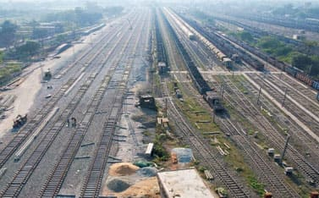
India’s railway network has carried the country’s freight for more than a century and a half, but for decades it has done so on tracks shared with passenger trains — a constraint that slows both. The Dedicated Freight Corridor (DFC) programme was conceived to change that, by building freight-only lines that run largely parallel to the existing network, freeing up capacity for passenger services while giving industry a faster, more reliable way to move goods.
As part of this national programme, GMR Infrastructure Limited was awarded Contract Package-201 and Contract Package-202 in 2015 on the Eastern Corridor — covering the development of a 417-kilometre dedicated freight corridor between New Bhaupur and New Deen Dayal Upadhyaya (DDY) stations in Uttar Pradesh.
GMR’s EPC team completed all 417 kilometres of track laying across Contract Package-201 and 202 — between New Bhaupur and DDY — by May 2023, and the section has since become a working part of the wider Eastern DFC network. More than 50 pairs of goods trains (figure to confirm current frequency with GMR/DFCCIL) now run on this stretch of the Dedicated Freight Corridor Corporation of India Limited (DFCCIL) network. Getting there was not straightforward: the project moved forward through constrained availability of construction material, the disruption of the COVID-19 pandemic, and difficult weather conditions across Uttar Pradesh’s plains. Through each of these challenges, GMR’s project team stayed on course, delivering a stretch of track that now forms part of one of India’s largest infrastructure undertakings since independence.
Engineering Highlight: The Yamuna River Bridge
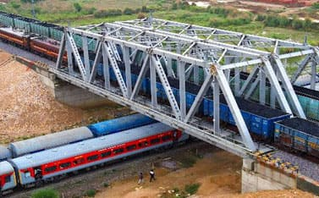
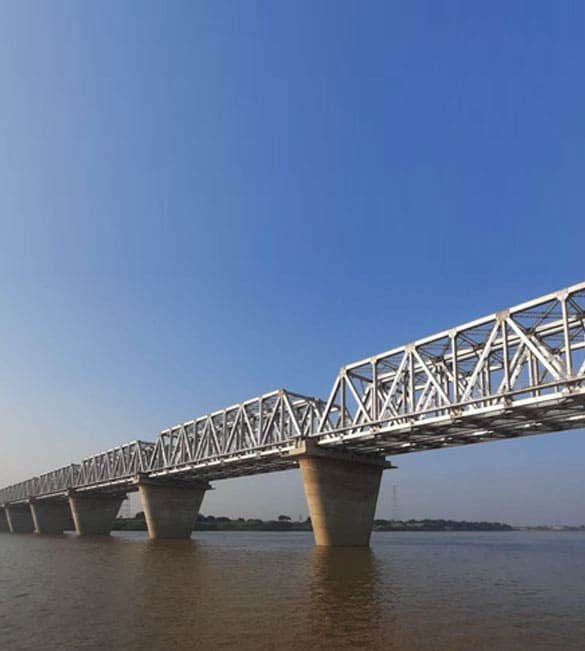
Among the structures built along this stretch, one stands out for its scale: a 1,040-metre (1.04 km) bridge carrying the freight corridor across the Yamuna River, built using 34 span girders. (Per-girder weight to be confirmed by GMR before publishing.) Bridges of this length across a major river are among the most technically demanding elements of any freight-corridor project, requiring girders to be fabricated, transported, and launched into place with a level of precision that leaves little room for error — particularly given the corridor’s design requirement to carry significantly heavier axle loads than India’s conventional rail network.
Completing this crossing was a turning point for the wider corridor. With the Yamuna span in place, freight trains can run at speeds of up to 100 km/h across a stretch of roughly 700 km, from Khurja to Chunar in Uttar Pradesh — a length of unbroken, high-speed freight track that did not exist on this alignment before GMR’s stretch was completed.
Why the Eastern Dedicated Freight Corridor Matters for Nation Building
The case for dedicated freight corridors is straightforward: freight and passenger trains have very different operating needs, and forcing them to share the same tracks slows both down. Around 70% of India’s freight trains are expected to shift onto dedicated freight corridors once fully operational, freeing up meaningful capacity on the conventional network for more passenger services — including, on this stretch, improved punctuality for existing Indian Railways services as goods trains move off the shared line.
DFC tracks are also engineered differently from conventional Indian Railways lines: they are built to carry heavier loads, allowing a single freight train to move significantly more cargo per trip. Beyond narrowing the gap between freight demand and supply, the corridor is designed to decongest India’s saturated road network and shift freight movement toward more efficient, lower-emission rail transport.
Along the route — including the Uttar Pradesh districts it passes through, such as Kanpur, Fatehpur, Kaushambi, Prayagraj, Mirzapur, and Chandauli (district list to confirm against GMR’s specific awarded stretch) — existing industrial areas are positioned to become key growth centres, while agricultural hubs along the corridor stand to benefit from faster, more reliable freight movement to the markets and ports that connect them to the rest of India and the world.
GMR’s Broader Role in Building India’s Infrastructure
The Eastern DFC stretch is one part of a broader body of infrastructure work GMR Group has undertaken across India. The Group’s portfolio spans airports, highways, energy, and urban infrastructure projects, delivered through a mix of public-private partnership and EPC models. Projects like the New Bhaupur–DDY stretch reflect the same disciplined, execution-focused approach GMR applies across its transportation and urban infrastructure business: designing and building assets intended to operate for decades, in service of connectivity goals set at a national level rather than a single state or sector.
As India continues to expand its freight-corridor network, sections like this one offer an early look at what the completed system is designed to deliver: faster freight movement, reduced road congestion, and stronger regional connectivity for the industries and communities along the route. For GMR, the project stands as a marker of the Group’s role in building infrastructure the country will rely on well beyond the year construction is finished.
FAQ Section
Q: What did GMR build on the Eastern Dedicated Freight Corridor?
A: GMR Infrastructure Limited was awarded Contract Package-201 and Contract Package-202 of the Eastern Dedicated Freight Corridor in 2015, covering a 417-kilometre stretch between New Bhaupur and New Deen Dayal Upadhyaya (DDY) stations in Uttar Pradesh.
Q: When was GMR’s stretch of the Eastern DFC completed?
A: GMR’s EPC team completed all 417 kilometres of track laying across Contract Package-201 and 202 by May 2023, following construction that continued through material-availability constraints, the COVID-19 pandemic, and difficult weather conditions.
Q: What is the significance of the Yamuna River bridge on this stretch?
A: The project includes a 1,040-metre (1.04 km) bridge over the Yamuna River, built using 34 span girders — one of the most notable structures on GMR’s awarded stretch of the corridor.
Q: How fast can freight trains run on the completed corridor?
A: The completed section allows freight trains to run at speeds of up to 100 km/h across a stretch of roughly 700 km, from Khurja to Chunar in Uttar Pradesh.
Q: Why does the Eastern Dedicated Freight Corridor matter for India?
A: Around 70% of India’s freight trains are expected to shift onto dedicated freight corridors, freeing capacity for more passenger trains, decongesting the road network, and shifting freight movement toward more efficient rail transport.
Q: How does the corridor support regional economic growth?
A: DFC tracks are built to carry heavier loads than most of the Indian Railways network. Along the corridor, existing industrial areas are positioned to become key growth centres, while agricultural hubs stand to benefit from faster, more reliable freight movement.